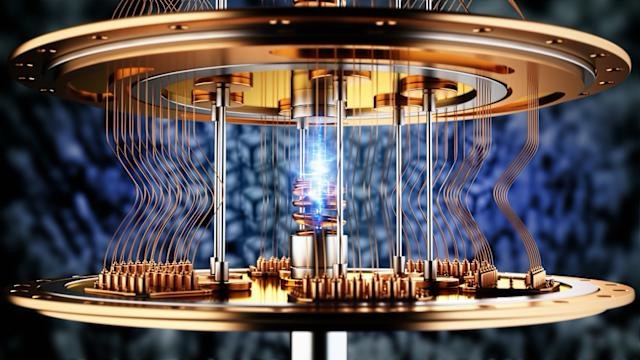
Quantum computers represent a paradigm shift in how we process information, harnessing the bizarre principles of quantum mechanics to tackle problems that are insurmountable for traditional computers. Unlike classical computers, which rely on bits that are either 0 or 1, quantum computers use qubits that can exist in multiple states simultaneously thanks to superposition. 0 This technology promises to revolutionize fields from cryptography to drug discovery, but it’s still in its nascent stages as of October 2025.
A Brief History of Quantum Computing
The roots of quantum computing trace back to the early 1980s when physicist Richard Feynman proposed that quantum systems could be simulated more efficiently using quantum-based hardware. 19 In 1980, Paul Benioff introduced the concept of a quantum Turing machine, laying the theoretical foundation. The field gained momentum in 1994 with Peter Shor’s algorithm, which could factor large integers exponentially faster than classical methods, threatening modern encryption. 19 Lov Grover’s search algorithm followed in 1996, offering quadratic speedups for unstructured data searches.
Experimental milestones began in the late 1990s with small-scale quantum computers using trapped ions and superconductors. Google’s 2019 claim of “quantum supremacy” with its 54-qubit Sycamore processor marked a turning point, though debated. 19 By 2025, advancements continue, with companies like IBM and Google pushing boundaries.
How Quantum Computers Work
At the heart of quantum computing are qubits, which can represent both 0 and 1 at the same time due to superposition. 6 When multiple qubits are entangled, the state of one instantly correlates with others, enabling parallel processing on a massive scale. Quantum operations are performed using gates, similar to logic gates in classical computing, but they manipulate probabilities through interference.
Quantum hardware typically includes a quantum data plane for qubits, control systems, and readout mechanisms, often requiring cryogenic temperatures to minimize noise. 5 Common approaches include superconducting circuits, trapped ions, and photonic systems.

Quantum algorithms exploit these properties. For instance, Shor’s algorithm uses the quantum Fourier transform to find factors, while Grover’s provides speedups for optimization problems.
Potential Applications
Quantum computers excel at simulating molecular interactions, accelerating drug discovery and materials science. 4 In finance, they could optimize portfolios and model complex economic systems. Cryptography faces both threats and opportunities: while Shor’s algorithm could break RSA encryption, quantum key distribution offers unbreakable security. 19
Other areas include machine learning, where quantum versions of neural networks could process vast datasets faster, and logistics optimization via quantum annealing. 19
Current State and Recent Developments in 2025
As of 2025, quantum computing is transitioning from theory to practical utility. IBM’s roadmap includes extending algorithms with high-performance computing (HPC) and demonstrating error correction. 17 Harvard physicists recently demonstrated a 3,000-qubit system, clearing a major hurdle for scalability.

NIST and the Superconducting Quantum Materials and Systems Center (SQMS) have led breakthroughs in qubit coherence, improving performance through nanofabrication. 18 McKinsey’s 2025 Quantum Technology Monitor highlights advancements in quantum sensing and communication, predicting real-world impacts soon. 10 Moody’s identifies trends like more experiments with logical qubits and specialized hardware. 15
Companies like PsiQuantum and Atom Computing are innovating, with roadmaps projecting hardware-accelerated algorithms in production by 2025-2026. 12 Microsoft urges businesses to become “quantum-ready” through hybrid applications and skilling. 13
Challenges and Limitations
Despite progress, challenges abound. Decoherence—where qubits lose their quantum state due to environmental interference—remains a key issue, necessitating error correction that requires thousands of physical qubits for each logical one. 19 Current “noisy intermediate-scale quantum” (NISQ) devices are error-prone and limited in scale.
Scalability, cryogenic requirements, and high costs hinder widespread adoption. Bain estimates potential impacts up to $250 billion but notes gradual realization. 14 Skeptics argue that hype outpaces reality, with many applications still theoretical.
The Future of Quantum Computing
Looking ahead, 2025 is dubbed “The Year of Quantum” by experts, with increasing investments and collaborations. 10 Fault-tolerant quantum computers could emerge in the next decade, unlocking unprecedented computational power. As hardware improves, hybrid quantum-classical systems will bridge the gap, making quantum tech accessible via cloud platforms like AWS and IBM.
In conclusion, quantum computers are poised to transform our world, but realizing their full potential will require overcoming significant technical hurdles. As research accelerates, the line between science fiction and reality continues to blur.