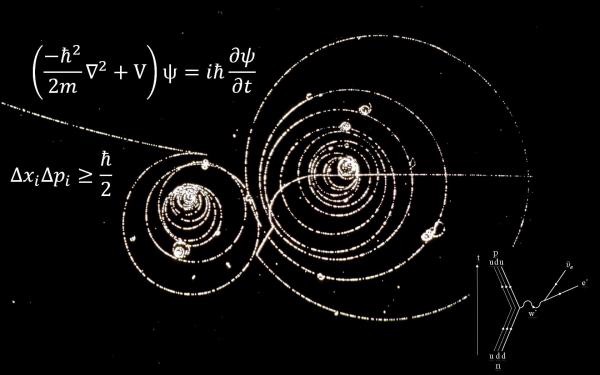
Are you gearing up for quantum mechanics exams, quantum physics quizzes, or quantum computing interviews? Dive into this curated list of top 30 quantum MCQ questions with answers covering quantum mechanics fundamentals, wave-particle duality, entanglement, qubits, and more. Perfect for students preparing for JEE, NEET, GATE, or tech roles at IBM or Google Quantum AI. Each question includes the correct answer and a concise explanation to solidify your concepts. Boost your quantum physics knowledge today—aim for 90%+ scores!
These quantum MCQs with answers are sourced from reliable educational platforms and updated for 2025 relevance. Ideal for quantum computing MCQs and quantum mechanics practice tests. Let’s quantum leap into the questions!
1. What does the term “quantum” literally mean in Latin?
a) How much
b) Wave function
c) Particle spin
d) Energy level
Answer: a) How much
Explanation: “Quantum” derives from Latin for “how much,” referring to discrete units of energy or matter in quantum theory, as seen in blackbody radiation and photoelectric effects.
2. Who proposed the probability interpretation of quantum mechanics?
a) Albert Einstein
b) Niels Bohr
c) Max Born
d) Werner Heisenberg
Answer: c) Max Born
Explanation: Max Born introduced the idea that the square of the wave function’s magnitude gives the probability density of finding a particle, earning him the 1954 Nobel Prize.
3. What is the basic unit of information in quantum computing?
a) Bit
b) Byte
c) Qubit
d) Giga
Answer: c) Qubit
Explanation: A qubit (quantum bit) can exist in superposition of 0 and 1 states, enabling quantum computers to process multiple possibilities simultaneously.
4. Which principle states it’s impossible to know both position and momentum precisely?
a) Pauli Exclusion
b) Heisenberg Uncertainty
c) Compton Effect
d) Bohr Correspondence
Answer: b) Heisenberg Uncertainty
Explanation: Heisenberg’s uncertainty principle (Δx Δp ≥ ħ/2) limits simultaneous measurement accuracy, a cornerstone of quantum indeterminacy.
5. In quantum mechanics, particles exhibit what dual behavior?
a) Mass-energy
b) Wave-particle
c) Charge-spin
d) Proton-neutron
Answer: b) Wave-particle
Explanation: Wave-particle duality, demonstrated by the double-slit experiment, shows electrons and photons behave as both waves and particles depending on observation.
6. What is superposition in quantum computing?
a) Qubits in a single state
b) Qubits in multiple states simultaneously
c) Classical bit flipping
d) Error correction
Answer: b) Qubits in multiple states simultaneously
Explanation: Superposition allows a qubit to represent 0, 1, or both, exponentially increasing computational power for algorithms like Grover’s search.
7. Who is considered the father of quantum theory for the photoelectric effect?
a) Max Planck
b) Albert Einstein
c) Erwin Schrödinger
d) Louis de Broglie
Answer: b) Albert Einstein
Explanation: Einstein’s 1905 explanation of the photoelectric effect using light quanta (photons) earned him the 1921 Nobel Prize and laid quantum foundations.
8. The Schrödinger equation describes what?
a) Relativistic particles
b) Time evolution of quantum systems
c) Classical orbits
d) Electromagnetic waves
Answer: b) Time evolution of quantum systems
Explanation: iħ ∂ψ/∂t = Ĥψ governs how wave functions evolve, central to non-relativistic quantum mechanics.
9. What is quantum entanglement?
a) Particles sharing energy
b) Linked particles with instant correlations
c) Wave collapse
d) Tunneling effect
Answer: b) Linked particles with instant correlations
Explanation: Entangled particles influence each other instantaneously, regardless of distance, as Einstein called “spooky action at a distance.”
10. What is the smallest discrete unit of physical properties in quantum theory?
a) Plank b) Quark c) Quant d) Photon **Answer: c) Quant** *Explanation: A quant (or quantum) is the minimal indivisible unit, like energy quanta E = hν proposed by Planck.*
11. Which quantum number describes orbital angular momentum?
a) Principal (n) b) Azimuthal (l) c) Magnetic (m) d) Spin (s) **Answer: b) Azimuthal (l)** *Explanation: l ranges from 0 to n-1, determining subshell shape (s, p, d, f).*
12. In quantum computing, what enables faster factoring?
a) Classical algorithms b) Shor's algorithm c) Binary search d) Sorting gates **Answer: b) Shor's algorithm** *Explanation: Shor's exploits quantum parallelism to factor large numbers exponentially faster, threatening RSA encryption.*
13. What did the Dirac equation predict?
a) Black holes b) Antiparticles c) Dark matter d) Neutrinos **Answer: b) Antiparticles** *Explanation: Dirac's relativistic equation implied every particle has an antiparticle with opposite charge, leading to positron discovery.*
14. The square of a particle’s wave function describes the probability of what?
a) Speed b) Location c) Charge d) Mass **Answer: b) Location** *Explanation: |ψ|² dx gives the probability density of finding the particle in dx, per Born's interpretation.*
15. What is a quantum gate analogous to?
a) Classical switch b) Reversible logic gate c) Memory cell d) Bus **Answer: b) Reversible logic gate** *Explanation: Quantum gates like Hadamard or CNOT are unitary and reversible, manipulating qubit states without information loss.*
16. Who said, “Anyone not shocked by quantum theory hasn’t understood it”?
a) Richard Feynman b) Niels Bohr c) Werner Heisenberg d) Paul Dirac **Answer: b) Niels Bohr** *Explanation: Bohr highlighted quantum mechanics' counterintuitive nature, central to the Copenhagen interpretation.*
17. What is quantum tunneling?
a) Particle escape from barriers b) Wave interference c) Spin flip d) Decoherence **Answer: a) Particle escape from barriers** *Explanation: Particles with insufficient energy probabilistically tunnel through potential barriers, key to nuclear fusion and flash memory.*
18. In qubits, what is coherence time?
a) Processing speed b) Duration before decoherence c) Entanglement strength d) Gate fidelity **Answer: b) Duration before decoherence** *Explanation: Coherence time measures how long a qubit maintains superposition before environmental noise disrupts it.*
19. What principle limits simultaneous position and momentum knowledge?
a) Complementarity b) Uncertainty c) Exclusion d) Correspondence **Answer: b) Uncertainty** *Explanation: Δx Δp ≥ ħ/2; measuring one disturbs the other, embodying quantum fuzziness.*
20. Which is NOT an interpretation of quantum mechanics?
a) Copenhagen b) Many-Worlds c) Pilot-Wave d) Classical Deterministic **Answer: d) Classical Deterministic** *Explanation: Classical determinism fails at quantum scales; interpretations like Copenhagen embrace probability.*
21. What does de Broglie’s hypothesis state?
a) E = mc² b) λ = h/p c) F = ma d) V = IR **Answer: b) λ = h/p** *Explanation: Matter has wave properties with wavelength inversely proportional to momentum, explaining electron diffraction.*
22. In quantum computing, what is Grover’s algorithm for?
a) Factoring b) Unstructured search c) Sorting d) Encryption **Answer: b) Unstructured search** *Explanation: Grover's provides quadratic speedup for database searches, useful in optimization.*
23. What is the ground state energy of a quantum harmonic oscillator?
a) 0 b) ħω/2 c) hν d) kT **Answer: b) ħω/2** *Explanation: Zero-point energy E₀ = (1/2)ħω persists even at absolute zero due to Heisenberg uncertainty.*
24. Quantum computers are relatively ___ than classical ones for certain tasks.
a) Slower b) Faster c) Equal d) Unreliable **Answer: b) Faster** *Explanation: Exponential speedup for problems like simulation and optimization, but not universal superiority.*
25. What is the Pauli Exclusion Principle?
a) No two electrons same quantum numbers b) Energy conservation c) Momentum equality d) Wave symmetry **Answer: a) No two electrons same quantum numbers** *Explanation: Explains electron shells and periodic table; fermions can't occupy identical states.*
26. What destroyed Heisenberg’s Helgoland guest house in 1925?
a) Storm b) Bomb c) Fire d) Earthquake **Answer: a) Storm** *Explanation: Heisenberg developed matrix mechanics there; the island's harsh weather symbolized quantum turmoil.*
27. In quantum mechanics, spin is what?
a) Classical rotation b) Intrinsic angular momentum c) Orbital path d) Charge property **Answer: b) Intrinsic angular momentum** *Explanation: Electrons have spin ±ħ/2, leading to magnetism and Stern-Gerlach experiment results.*
28. What is a Bloch sphere?
a) Qubit state visualization b) Energy level diagram c) Wave function plot d) Gate array **Answer: a) Qubit state visualization** *Explanation: Represents pure qubit states on a unit sphere, with poles as |0⟩ and |1⟩.*
29. The Compton effect demonstrates what?
a) Wave bending b) Photon-electron scattering c) Pair production d) Annihilation **Answer: b) Photon-electron scattering** *Explanation: Wavelength shift confirms photon particle nature, supporting quantum theory.*
30. What is decoherence in quantum systems?
a) Superposition enhancement b) Loss of quantum behavior due to environment c) Entanglement creation d) Gate operation **Answer: b) Loss of quantum behavior due to environment** *Explanation: Interactions cause classical-like outcomes, a major challenge for scalable quantum computing.*
Why Practice These Quantum MCQs?
These top 30 quantum MCQ questions with answers blend quantum mechanics basics and quantum computing concepts, tailored for quantum physics exams and tech interviews. Regular drills sharpen problem-solving for quantum quizzes in physics or computer science. Track progress and revisit weak areas!
Pro Tip for SEO: Boost visibility with #QuantumMCQs #QuantumPhysics #QuantumComputing on LinkedIn or Reddit.
Download PDF: [Free Quantum MCQs PDF Download] (Host for easy access).
Need more on quantum entanglement MCQs or Schrödinger equation questions? Drop a comment! Stay quantum-curious in 2025!